
Europe – Proof That Road Safety Works
This article is based on insights and data from the International Road Federation’s “The Uneven Road to Zero: Data Gaps and Disparities in Global Road Safety,” published on the IRF World Road Statistics website.
When we think about more cars on the road, it’s easy to assume that more vehicles automatically mean more accidents and deaths. Yet Europe tells a very different story. Despite having a highly motorised population, European countries account for only about 7–8% of global road fatalities. This shows that rising motorisation doesn’t have to come with a rising toll — with the right policies, infrastructure, and enforcement, road deaths are not inevitable.
Safer Roads Per Capita
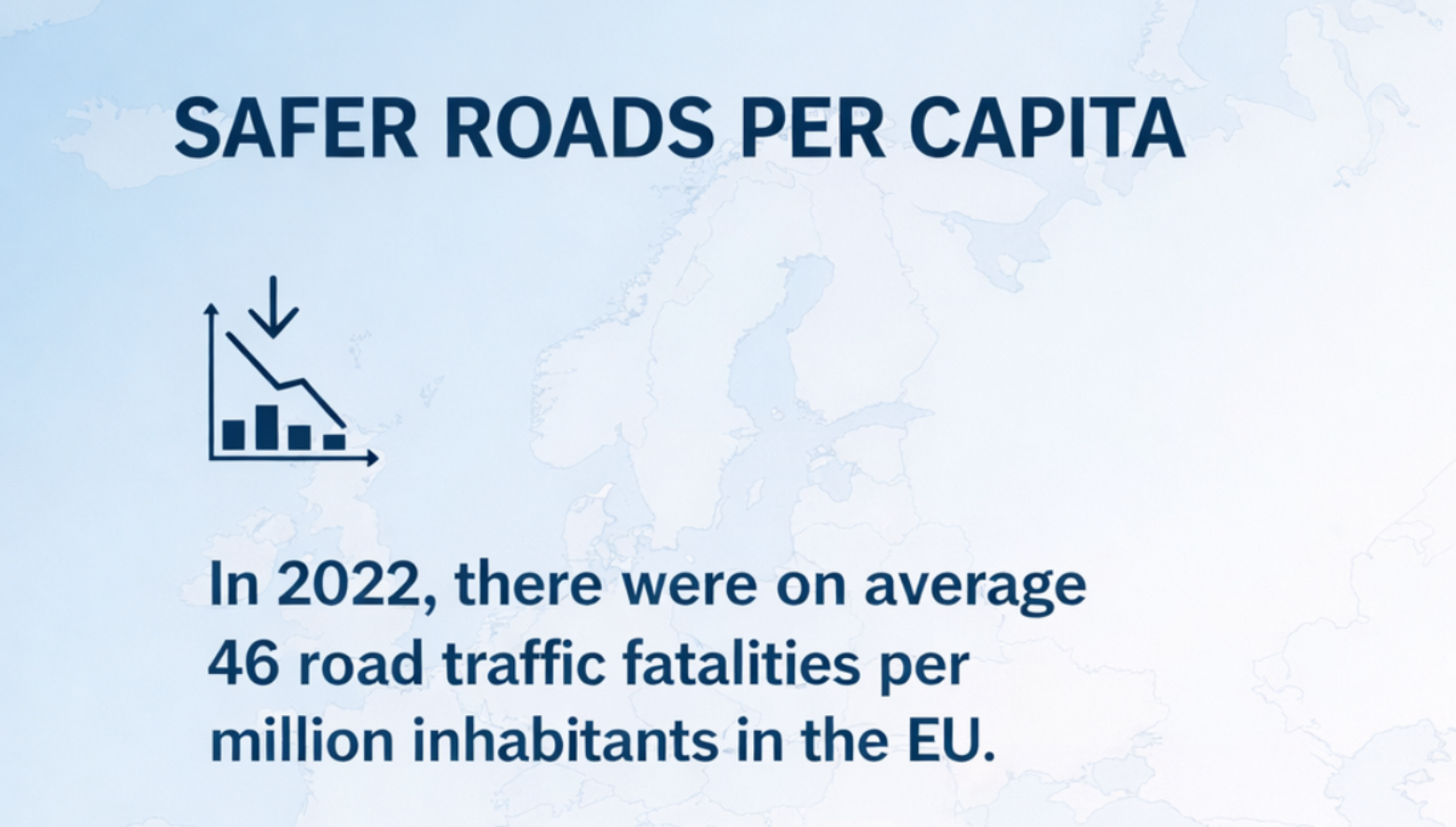
Looking closer at the numbers, Europe’s road safety success becomes even clearer. In 2022, the European Union recorded an average of 46 road traffic fatalities per million inhabitants. Some countries stand out even more: Sweden had just 22, Denmark 26, and Ireland 31 fatalities per million. These figures show that strong safety systems — including better infrastructure, strict enforcement, and public awareness — can dramatically reduce deaths on the road, even in highly motorised nations.
Decades of Safety Improvement
Europe’s road safety success is the result of sustained, decades-long effort rather than quick fixes. Over the past 30 years, road fatalities have steadily declined, even as vehicle ownership and traffic volumes grew significantly. This improvement is driven by a combination of strategies: upgrading road infrastructure to reduce dangerous intersections and high-risk zones, implementing stricter traffic laws and speed enforcement, and setting higher safety standards for vehicles, including mandatory airbags and advanced braking systems. Public awareness campaigns on seatbelt use, drunk driving, and safe speed also play a critical role. Together, these measures demonstrate that reducing road deaths is achievable with consistent, coordinated action — a clear proof that rising motorisation does not have to mean more fatalities.
Top Performers Show What’s Possible
Some European countries have set the global benchmark for road safety, proving what ambitious policies and strong systems can achieve. Sweden, Denmark, and Ireland consistently report the lowest road fatality rates in the EU, thanks to their comprehensive safety approaches. For example, Sweden’s “Vision Zero” strategy, launched in 1997, aims to eliminate all traffic deaths and serious injuries through safe road design, speed management, and strict enforcement. Denmark focuses on a mix of high-quality infrastructure, cyclist and pedestrian safety, and targeted awareness campaigns. Ireland has invested heavily in speed control, seatbelt enforcement, and advanced driver training. These countries show that data-driven policies, combined with continuous monitoring and adaptation, can dramatically reduce fatalities — even in regions with high traffic volumes.
A Hopeful Benchmark for the World
Europe’s experience offers a powerful lesson for countries around the globe: road deaths are preventable. The continent demonstrates that with the right mix of policies, infrastructure, enforcement, and public education, countries can reduce fatalities even as more people take to the roads. Europe’s success provides a roadmap for other regions struggling with high traffic deaths, showing that systematic, data-driven safety measures save lives. Rising motorisation does not have to mean rising deaths — and Europe proves what’s possible when safety comes first.

