
How Wide Should Your Dashcam’s Viewing Angle Be?

When comparing dashcams, you’ll often notice that most models list a Field of View (FOV) between 140° and 170°. It’s a common specification, but not always one people pay close attention to—or fully understand.
FOV simply defines how much of the road the camera can capture at once, but it also influences how clearly important details appear in the footage. There’s reason manufacturers consistently stay within this range, and understanding it can help you choose a dashcam that delivers footage that’s both comprehensive and clear.
Understanding FOV: Coverage vs Clarity
At its simplest, Field of View (FOV) describes how wide an area your dashcam can capture. A wider angle includes more of the scene—additional lanes, sidewalks, and surroundings—while a narrower angle focuses more tightly on what’s directly ahead.
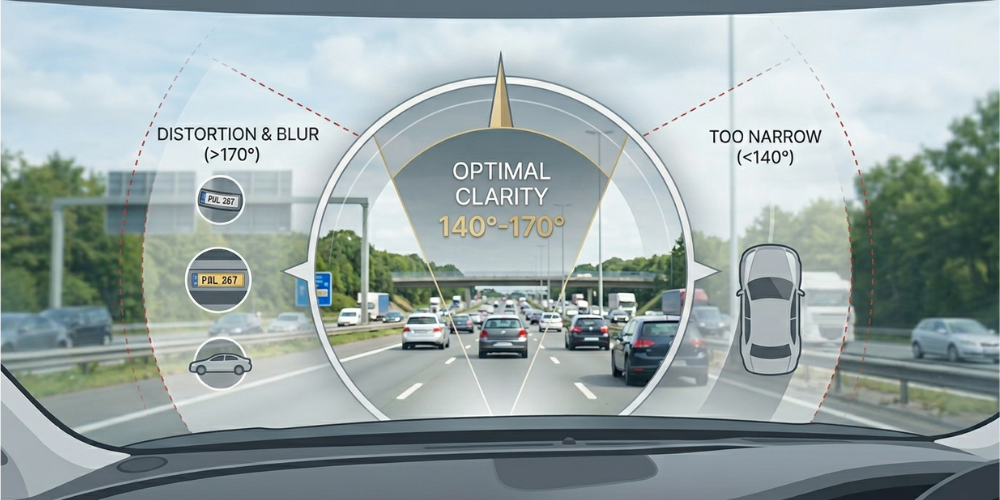
However, this comes with a trade-off. As the viewing angle increases, each object in the frame occupies a smaller portion of the image. This can introduce slight distortion around the edges and reduce how clearly details—such as number plates—are captured. In practice, FOV isn’t just about seeing more, but about balancing coverage with usable clarity.
When FOV Is Too Narrow (<140°)
A narrower field of view places more focus on what’s directly ahead, which can help preserve detail in the centre of the frame. However, this comes at the cost of overall coverage.
In real-world driving, important events don’t always happen directly in front of the vehicle. For example, if a car suddenly merges into your lane from the side, a narrow FOV may only capture the moment after it has already entered your path—missing how the situation began. While the image may appear more focused, the reduced field can mean losing important context.
When FOV Is Too Wide (>170°)
At the other end, a very wide field of view captures more of the surroundings, including peripheral areas that narrower lenses might miss. On paper, this can seem like an advantage.
Created with Gemini
In practice, however, pushing FOV too wide introduces visible distortion, particularly toward the edges of the frame. Objects appear smaller and slightly stretched, which can make important details harder to identify. For instance, a vehicle directly ahead may be clearly visible, but its number plate could appear too small or slightly warped to read accurately. While more is visible, the overall usefulness of the footage can be reduced.
The Ideal Range: 140°–170° (And What to Check Alongside It)
For most driving situations, a field of view between 140° and 170° offers a practical balance between coverage and clarity. It’s wide enough to capture multiple lanes and surrounding activity, while still maintaining enough detail to clearly record important elements like number plates.
This range reflects real-world usability rather than just specifications. It ensures that footage provides both context and clarity—showing what happened, and capturing it in a way that can be relied on when needed.
It’s also worth keeping in mind that FOV works alongside other factors. Image sensor quality, HDR performance, and lens design all play a role in how clear and usable the final footage is. A well-balanced combination of these elements is what ultimately defines dashcam performance.
Conclusion
Field of View is often seen as just another number on the spec sheet, but it has a direct impact on how useful your dashcam footage will be in everyday situations.
Rather than focusing on the widest possible angle, it’s more effective to look for a balanced range—typically between 140° and 170°—where both coverage and clarity are maintained. This ensures that your dashcam not only captures the scene, but records it with enough detail to be meaningful when it matters.