
Does Tesla Sentry Mode Replace a Dedicated Dashcam?
Generated with OpenAI ChatGPT
If you drive a Tesla, you already have access to one of the most innovative security features on the market: Sentry Mode and the integrated Tesla Dashcam. By utilizing the vehicle’s built-in cameras, Tesla provides automated perimeter monitoring without requiring any extra hardware out of the box.
Naturally, many owners ask: Do I actually need a dedicated dashcam if my car already has Sentry Mode?
The short answer is no—Sentry Mode does not fully replace a dedicated dashcam.
While Tesla’s built-in system is a great first line of defense, it was designed with different technical priorities than a purpose-built dashcam. Understanding where the built-in system excels—and where dedicated hardware fills critical gaps—helps clarify why many EV owners choose to use both.
Crash Reliability & File Preservation
In a severe collision, a vehicle’s main electrical system or 12V battery can suddenly lose power upon impact. Because Tesla’s system writes video footage continuously to a USB drive in the glovebox, an immediate cut in power can interrupt the file writing process, leaving the most crucial seconds of the accident corrupted or unreadable.
How dedicated dashcams solve this: Quality aftermarket dashcams feature internal supercapacitors. These act as emergency power reserves that hold just enough energy to safely finalize and lock the video file to the memory card, even if total vehicle power is cut instantaneously.
Audio Evidence & Optical Precision
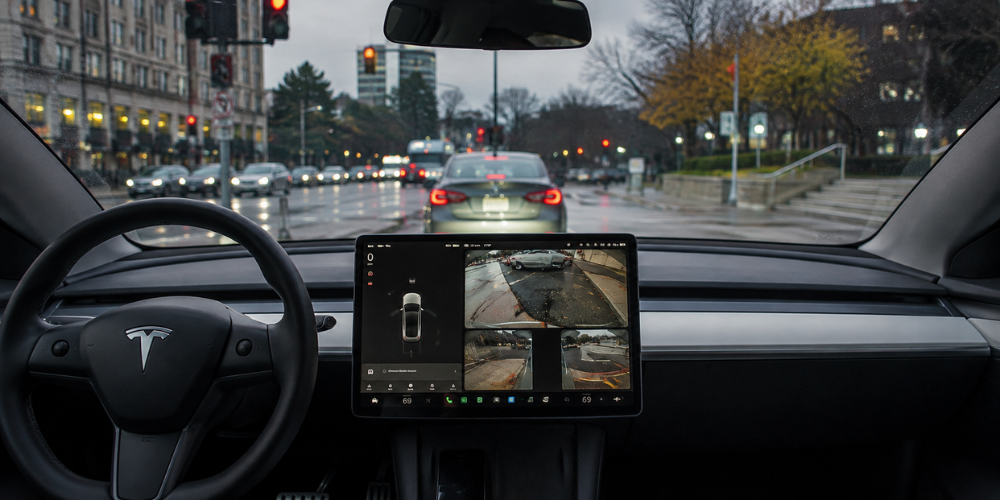
Tesla’s external cameras were engineered primarily for the vehicle’s computer vision and autonomous driving features (like FSD). They are calibrated for machine perception rather than human visual inspection.
Audio Context: Tesla records zero audio (neither interior nor exterior). Audio is often the single most vital piece of evidence in traffic disputes, road rage incidents, or police interactions.
Optical Detail: Dedicated dashcam sensors are fine-tuned for high dynamic range (HDR) and low-light license plate clarity. Additionally, Tesla’s rear footage relies on the low bumper backup camera—which frequently gets coated in dirt, snow, or road spray—whereas dedicated rear dashcams sit cleanly inside the upper rear windshield.
Generated with OpenAI ChatGPT
Battery Efficiency in Parking Mode
Sentry Mode is a fantastic guard while parked, but to run its computer vision algorithms, it must keep the vehicle’s main computer continuously awake. This process uses around 200–300 watts of power, leading to “phantom drain” (typically 1 to 2 miles of range lost per hour). If you leave your car parked for several days at an airport or garage, Sentry Mode will eventually turn off automatically once the battery drops to 20%.
How dedicated dashcams solve this: Dedicated dashcams use dedicated low-power sensors (such as motion or radar detection) that draw a fraction of the energy. When paired with an independent dashcam battery pack, a dedicated camera can monitor your vehicle for days in parking mode with zero drain on your EV’s main battery.
Feature Overview
Capability |
Tesla Built-in (Sentry / Dashcam) |
Dedicated Premium Dashcam System |
| Out-of-the-Box Setup | Built-in (Seamless) | Requires low-profile installation |
| Emergency Power Reserve | Dependent on 12V system | Supercapacitor failsafe file saving |
| Audio Recording | No (Visual only) | Yes (Cabin & exterior audio) |
| Battery Drain (Parked) | High (Keeps car computer awake) | Minimal (Can run off standalone powerpack) |
| Camera Viewpoints | Side fenders, front windscreen, rear bumper | Front windscreen, top-rear window, interior |
The Takeaway
Tesla deserves immense credit for making vehicle recording standard—Sentry Mode has set a new security benchmark for the automotive industry.
However, thinking of Sentry Mode and a dedicated dashcam as complementary tools rather than mutually exclusive choices gives you the best protection:
- Sentry Mode provides incredible perimeter surveillance for casual parking and everyday security.
- A dedicated dashcam serves as an indispensable flight recorder—ensuring crash-resilient video saving, audio capture, and long-term parking surveillance without range anxiety.