
More Cars = Mean Safer Roads??

As countries develop, car ownership tends to rise, often bringing with it the belief that roads will naturally become safer. More vehicles are commonly seen as a sign of improved infrastructure and modern transport systems. However, data from the International Road Federation (IRF) presents a different picture. In many parts of the world, an increase in the number of cars does not lead to fewer road fatalities. Instead, the data highlights a more complex reality—one where road safety outcomes depend on how transport systems evolve, not simply on the number of vehicles on the road.
More Vehicles, More Risk
When more cars hit the road, it often means people are moving more, goods are being transported, and economies are growing. But higher numbers of vehicles also mean greater exposure to crashes and dangerous situations if safety systems don’t keep up. Global data shows that as motorisation rises — measured by the number of vehicles on the road per person — the likelihood of serious or fatal crashes tends to go up in many countries where road safety infrastructure, enforcement, and planning are still developing. This pattern holds across regions with rising vehicle ownership but limited resources for safe road design or strong traffic laws, resulting in a higher risk of road traffic fatalities and injuries as cars become more common.
Motorization Is Outpacing Safety
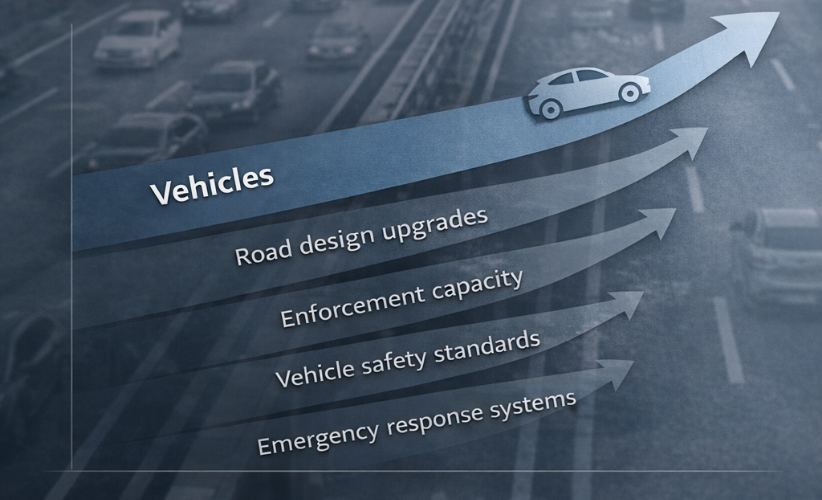
As the number of vehicles on the world’s roads continues to grow, the systems that make travel safe are not always keeping up. According to the International Road Federation’s analysis of global statistics, there is a clear link between rising motorisation and increased road death risks in many regions — simply adding more cars to the road often comes with greater exposure to crashes and danger if safety measures are lagging behind. This pattern shows that roads can become more hazardous when vehicle growth outpaces investment in safer infrastructure, stronger traffic law enforcement, and robust safety systems that protect people. Across continents, as vehicle ownership increases, so does the likelihood of fatal crashes unless deliberate efforts are made to manage that growth with safety in mind.
A Different Outcome in Europe
In contrast to many regions where rising car ownership has been linked with higher road-death risks, Europe shows a different pattern. Despite continued growth in the number of vehicles on its roads, Europe has managed to reduce overall road fatalities over time and maintain some of the lowest death rates per population compared with global averages. Data from official regional statistics indicate that the European Union had around 45–46 road traffic deaths per million people in recent years (European Road Safety Charter, 2024), a figure that remains relatively low considering the level of motorization, and represents a decline from earlier years as safety systems have improved.
This outcome suggests that stronger traffic laws, better infrastructure design, vehicle safety standards, and targeted interventions can help decouple rising motorization from fatal crashes — meaning that more cars do not necessarily have to result in more deaths. While improvement is still uneven across member states, with some countries progressing faster than others, Europe’s overall trajectory shows how coordinated safety efforts can change the direction of road-safety trends even as vehicle numbers grow.
Safety Is a System, Not a Single Factor
Road safety does not improve through one change alone. It is the result of an entire system working together. When vehicle numbers increase, safety depends on whether roads are designed to handle that growth, whether traffic rules are enforced consistently, and whether vehicles themselves meet basic safety standards. Strong enforcement helps reduce risky behaviour, safer vehicles lower the severity of crashes, and clear accountability ensures that safety is treated as a shared responsibility rather than an afterthought. Where these elements are missing or uneven, rising motorisation tends to expose weaknesses in the system, leading to higher risks on the road.
Safety Does Not Happen Automatically
Safer roads are not a guaranteed outcome of development or rising car ownership. They are the result of intentional action and continuous monitoring. Without active measures, increased traffic simply increases risk. Tools such as speed cameras, GPS tracking, and real-time driver feedback play an important role in making safety visible and measurable. They help identify risky behaviour, encourage safer driving habits, and support accountability on the road. When used as part of a broader safety approach, these measures help ensure that safety improves alongside motorisation rather than falling behind it.