
Africa – The Invisible Road Safety Crisis
This article is based on insights and data from the International Road Federation’s “The Uneven Road to Zero: Data Gaps and Disparities in Global Road Safety,” published on the IRF World Road Statistics website.
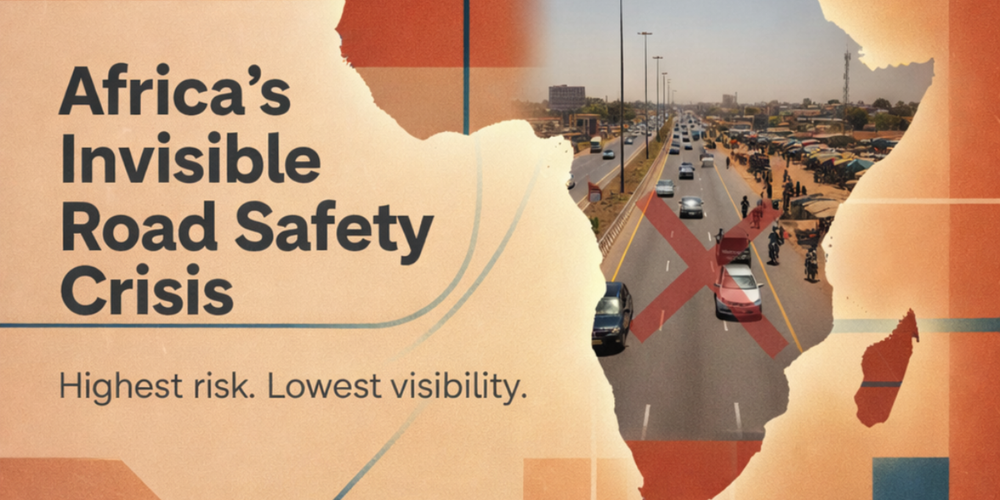
Africa’s road safety crisis is one of the most severe—and least visible—in the world. Despite recording the highest road traffic death rate globally, the scale of the problem often remains underestimated in policy discussions and public awareness. Crashes, injuries, and fatalities are frequently underreported, leaving large gaps between what happens on the road and what appears in official statistics. This invisibility has consequences. When risks are not fully measured, they are harder to prioritize, fund, and fix. Understanding Africa’s road safety challenge therefore requires looking not only at the numbers we have, but also at the data that never makes it into the system.
The World’s Highest Road Death Rate
Africa has the highest road traffic death rate of any region in the world, at 18.8 deaths per 100,000 people. This figure is more than three times higher than that of many high-income regions and well above the global average. Importantly, this is a rate, not just a reflection of population size—it indicates a significantly higher risk of dying on the road. Factors such as rapid urban growth, mixed traffic conditions, limited road infrastructure, and weak enforcement all contribute to this elevated risk. Yet even this stark statistic likely understates the true scale of the problem, as many road deaths never enter official records.
Rising Injuries Signal Growing Risk
Beyond fatalities, injury trends point to a worsening safety environment across much of Africa. According to available estimates, road traffic injuries in the region have increased by approximately 19.5 percent in recent years. Rising injuries reflect growing exposure as motorization increases and more people share limited road space, often without adequate protection. They also signal weak prevention and post-crash systems, where crashes that could be minor instead result in serious harm. Injuries are a critical indicator because they reveal risk earlier than fatalities—but when injury data is incomplete or inconsistent, these warning signs are easy to miss.

Severe Underreporting Masks the True Scale
One of the defining features of Africa’s road safety crisis is the scale of underreporting. In many countries, official police data captures only a fraction of actual road deaths and injuries, with large gaps between reported figures and WHO estimates. Crashes involving pedestrians, cyclists, and motorcyclists are particularly likely to go unrecorded, especially when deaths occur after the crash or outside formal medical settings. Weak data systems, limited resources, and inconsistent reporting standards mean that the true human cost of road traffic injuries remains largely hidden. This lack of reliable data does more than distort statistics—it limits political urgency, skews funding decisions, and makes effective intervention harder to design and evaluate.
Weak Systems Before and After the Crash
Underreporting is closely linked to deeper systemic weaknesses that shape crash outcomes across much of the region. Many roads lack basic safety features such as clear signage, pedestrian crossings, lighting, and physical separation between fast-moving vehicles and vulnerable users. Enforcement of speed limits, helmet use, and drink-driving laws is often inconsistent, reducing deterrence. After a crash, delayed detection, limited ambulance coverage, and gaps in trauma care mean that injuries which might be survivable elsewhere can quickly become fatal. These weaknesses reinforce one another: poor systems increase harm, and poor data obscures where systems fail most.
Why Data Is the Foundation of Accountability
Data is the starting point for accountability—and in Africa, this foundation is often missing. Without reliable information on where crashes occur, who is most affected, and what factors contribute to injury and death, road safety risks remain abstract and easy to ignore. Incomplete data weakens enforcement, limits targeted infrastructure investment, and makes it difficult to evaluate whether policies are working. By contrast, countries that have improved crash reporting, injury surveillance, and data integration across police, health, and transport systems are better able to direct resources where they are needed most. Measurement turns road safety from a hidden problem into a visible responsibility.